Mortgage Amortization Schedules – The Complete Guide

Spitzer, equal principal, or bullet? Understanding the numbers behind your mortgage and how choosing the right amortization schedule affects your wallet for years to come.

Schedule a Consultation Call

What is an Amortization Schedule and Why is it Important?

When we approach taking out a mortgage, most of our attention is usually focused on selecting the tracks (prime, fixed, variable) and the interest rate level. However, there is another critical component that dramatically affects the monthly payment and the total interest we'll pay to the bank in the end – this is the amortization schedule. As part of professional mortgage consulting, we place great emphasis on matching the loan repayment method to the family's financial capabilities, not only in the present but also in the future.

An amortization schedule is essentially the table that defines how much we'll pay each month toward the principal (the amount we borrowed) and how much toward interest. Understanding this mechanism is vital for anyone planning first-time home buyer mortgage consultation or considering refinancing, as the choice between a Spitzer schedule and equal principal can change the repayment picture by thousands of shekels.

Spitzer Schedule – The Common Method

The Spitzer schedule is the most common repayment method in Israel and the Western world. The guiding principle of this method is that the monthly payment (before indexation and interest rate changes) remains fixed throughout the entire life of the loan.

How does it work? At the beginning, the lion's share of the monthly payment consists of interest payment, and only a small portion reduces the principal. As time passes, the ratio reverses: the interest component decreases and the principal component increases. This is an excellent solution for young couples seeking stability in cash flow.

  • Advantage: Relatively low initial monthly payment allowing compliance with proper payment ratio.
  • Disadvantage: Slow debt repayment rate in the early years ("eating the interest").

גרף לוח שפיצר
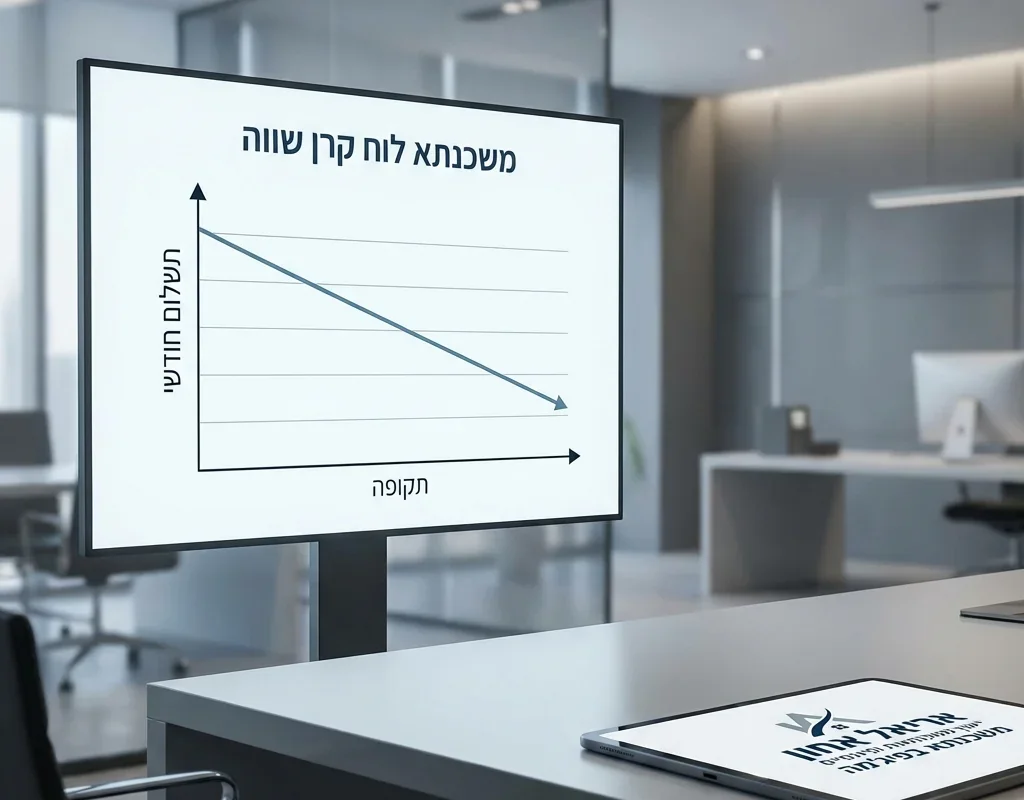
גרף קרן שווה

Equal Principal Schedule – For Those Paying More Initially

In the "equal principal" method, the amount that reduces the principal (the original debt) is fixed in each payment. Interest is calculated on the remaining debt balance which keeps decreasing, so the total monthly payment starts high and decreases steadily over the years.

This method is particularly suitable in the context of mortgage consultation for home upgraders or people with high current repayment capacity who want to save on total interest payments over the life of the loan. The interest savings can reach tens of thousands of shekels compared to the Spitzer schedule.

  • Advantage: Lower total interest payment and faster debt repayment rate.
  • Disadvantage: Requires very high monthly repayment capacity at the beginning.

Quick Comparison: What's Right for You?

Who is Spitzer suitable for?

Suitable for most borrowers, especially young couples in the process of purchasing their first home who need a low initial monthly payment to meet the repayment ratio required by the bank.

The bottom line: stability and convenience in cash flow.

Who is Equal Principal suitable for?

Suitable for those with high and available income, or older people who want to finish the mortgage as quickly as possible and pay minimum interest to the bank.

The bottom line: maximum interest savings.

What about a Balloon (Grace) loan?

In this method, you pay only interest (or nothing) for a defined period, and the principal at the end. Suitable as a bridging solution, for example for home upgraders waiting to sell their old property.

The bottom line: excellent temporary solution.

The Impact of the Index on Amortization Schedules

Important to remember: The term "fixed payment" in the Spitzer schedule is only accurate as long as the interest rate doesn't change and the principal isn't linked to an index. In index-linked tracks, the principal balance is updated monthly according to changes in the Consumer Price Index. When the principal increases, both the interest calculation and the monthly payment are updated upward.

In the process of mortgage refinancing and improving terms, we examine not only the interest rates but also the linkage composition and the amortization schedule. Sometimes, switching from a Spitzer schedule to Equal Principal (if cash flow allows) can provide better protection against inflation, as the principal erodes faster.

Expert tip:

Don't just look at the first payment! Ask the advisor or bank for a simulation showing the development of the monthly payment under realistic inflation assumptions. What seems cheap today could prove very expensive in 5 years.

Undecided about which amortization schedule to choose?

Building the right mortgage mix requires broad vision and deep understanding of the numbers. We're here to help you save tens of thousands of shekels and tailor the mortgage exactly to your needs.